 Mihai - Cristian Ioniță
What are tornadoes and how they form
Some experts claim that tornadoes are the worst kind of storms and they are defined as violently rotating columns of air extending from a thunderstorm to the ground. They can be narrower (like those forming in Europe) or wider (such as the ones that hit the US and Canada - for example, in central USA there are a few states that are located in an area known as ”Tornado Alley” that is very prone to the formation of tornadoes) and it's quite difficult, if not impossible, to spot them early-on, unless dust and debris is being carried.
Tornadoes occur pretty much everywhere on Earth, despite those in the US and Canada usually being the most devastating. Every continent sees tornadoes at least once a year, so you find them in South America, Europe, Africa, Asia, Oceania and of course, North America. Outside the US, Bangladesh and Argentina seem to be the two larger hotspots for tornadoes.
To put things into perspective, Argentina is hit by around 7 tornadoes per year, while New Zealand, for example, by 20, but get ready for this, the US is battered by around 1.200 each year, with recordings going as far back as 1950.
Because they are such a strong and dangerous extreme weather events, researchers don't have much of a chance when it comes to studying tornadoes and how exactly they form, so we can only guess based on our knowledge about thunderstorms and meteorological data.
A tornado usually forms when certain conditions are met during a rotating thunderstorm, called a supercell, where the air needs to circulate in a certain way. Winds that move in different directions, at different speeds and altitudes cause the rising air to start spinning.
However, not all thunderstorms involving spinning air cause a tornado, as it's important that the air near the ground starts spinning, as well. That usually happens when large amounts of warm air start moving upwards and other large amounts of cold air are pushed down, destabilizing the atmosphere near the ground.
This is why tornadoes mostly occur during the transition from the cold to the hot season, between March and June.
The most dangerous tornadoes ever recorded
To get an idea of how powerful and dangerous tornadoes are, some of the most incredible images that you can find online showed plastic straws puncturing aluminum roofs or tree branches getting dug in the asphalt. That's only mentioning the family-friendly type of damage that we can talk about here.
One of the worst tornadoes in our history (at least those that we have records of) took place almost a century ago; known as the Tri-State tornado, this took 695 lives as it crossed the states of Indiana, Missouri and Illinois. The tornado, which destroyed multiple towns and farms, travelled for 352 kilometers, the longest distance for a single tornado. Its winds, reaching up to 483 km/h would be enough to classify this as an F5 tornado, the worst type.
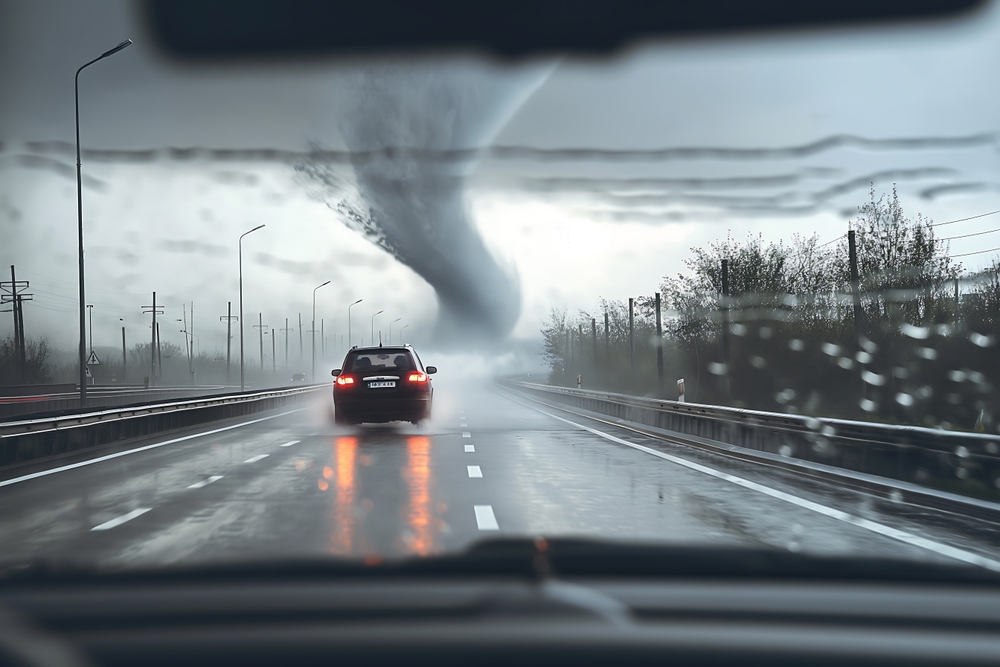
Most of the deadliest twisters that you'll find information about on the internet took place in the US, but one in particular happened in Malta around 1550. I know, that's a very long time ago but it was so deadly and unexpected that it made it in the history books. Hitting the capital city of Valetta, the tornado took around 600 lives.
Utrecht in Netherlands was also hit by a powerful tornado back in 1674, which effectively wiped the entire city and destroyed every roof and building in its path, with the exception of the Dom Tower, which still stands in the city today. Not much is known about that even outside this information, but we can speculate that there were many casualties, as the buildings themselves stood no chance.
How and where to take shelter from tornadoes
The sort of good news is that throughout the years, we've developed ways to take shelter if and when a tornado hits and if you live in a tornado-prone area, chances are that you have more defense mechanisms that someone living in Eastern Europe, for example.
If you're inside a house, the best bet is heading for the basement, but if that's not possible, a small room, such as a bathroom or a closet is your second-best option. Whatever you do, stay away from the windows and to boost your chances, you can also take cover under a table or a desk to stay sheltered from debris.
Also, avoid being on any other floor than the ground one and definitely don't take the elevator, as the power often gets cut during tornadoes. If you're being stranded inside a building with a wide-span roof, like a church or a gymnasium, and you can't leave, make sure to take cover under something sturdy, because that roof is likely to collapse when the tornado crosses it.
A general rule of thumb, if you're outside and looking at a tornado that seems to be stationary, well it's not and it is moving right towards you. And if you're being caught while driving, find shelter in the nearest ditch, covering your head from flying debris, if you can't find solid shelter nearby.



Any thoughts?