 Mihai - Cristian Ioniță
Firstly, what is the Mercedes-Benz EQE 300? It's basically Mercedes' answer for a long-distance electric vehicle that takes you to your destination in superior comfort. Practically, the EQE is the electric equivalent of an E-Class and over it is the EQS model, which is essentially an electrified S-Class and maybe we'll drive one of those one day, as well.
Mercedes-Benz EQE is a sustainably-made limousine
At Mercedes-Benz, the sustainability strategy is based not only on the electrification of the vehicle line-up, but also on the materials manufactured with the planet in mind. The EQE is the company's second EV manufactured on the EVA2 architecture after the EQS, which is essentially an architecture designed for large-size electric vehicles, such as limousines and SUVs.
According to Mercedes engineers, the propulsion systems developed for the entire EQE line-up of cars are using permanently excited synchronous motors (PSM), offering sustained performance for longer sessions, without compromising on the acceleration feel, while also being more energy efficient.
EQE comes in multiple engine options and with batteries that vary from 98 kWh to 105 kWh. As far as the batteries developed for this model are concerned, engineers at Mercedes allow constant software updates to optimize performance, range and efficiency.
Also, Mercedes optimized the production process in order to reduce the use of cobalt by up to 10%.
After the batteries age throughout the years and are no longer suitable to be used as traction batteries for the company's range of cars, they are turned into stationary energy storage solution and only then are they being recycled. Mercedes invested in a home-made battery recycling facility in Germany since 2023 to allow for the reprocessing of spent cells.
The batteries installed in the EQE are certified for optimal performance on a period of 10 years or 250.000 kilometers.
The Mercedes-Benz EQE is manufactured partially with sustainable materials. Thus, 184 of the materials installed in the vehicle, amounting to around 78 kilograms, are made with raw materials that have a lower impact on the planet.
The whole report regarding the reduced emissions from the production of the Mercedes EQE can be read here.
How is it to drive an electric limousine like the Mercedes-Benz EQE on a long distance
Being basically a battery version of the E-Class, the EQE 300 feels the best on a long trip, either on the highway, national or express roads, so at higher speeds. At 120 km/h, the car feels almost as if it's at a standstill, while at 130 km/h, the comfort is still very good.
You can't hear almost any noise from the outside, not even the wind and only if there's a motorcycle passing-by at a faster speed. You can easily carry a conversation with the passengers without raising your voice and you can comfortably listen to music at less than 25%.
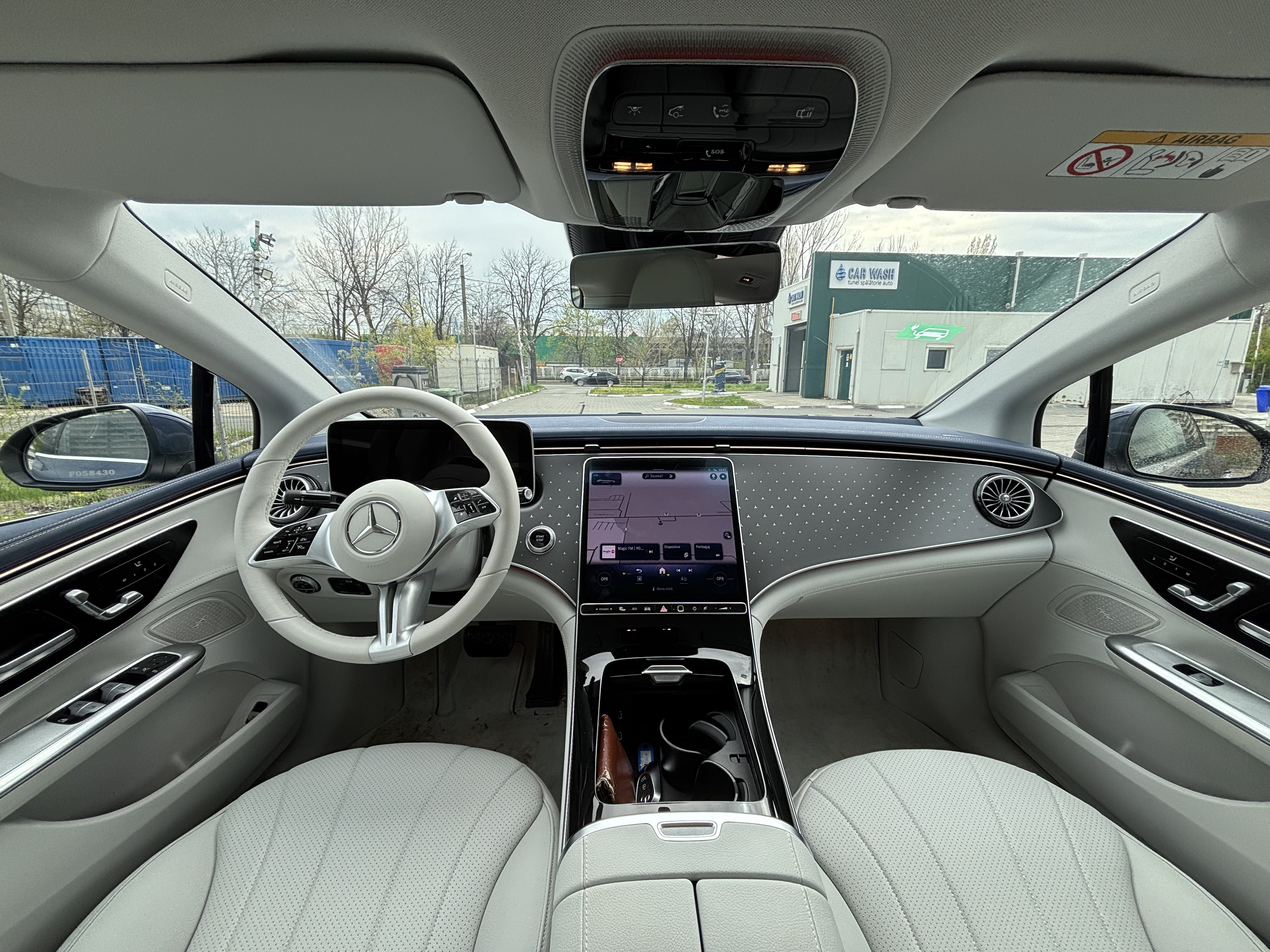
Even at the aforementioned speeds, the car almost drives by itself and the indentations in the roads are barely being felt, despite the fact that our model didn't have the AIRMATIC suspension, but rather, the standard one. It's clear that this car was made for driving on long journeys and not for the city, where the larger dimensions don't make it ideal for squeezing in tight spots.
The model we tested was an EQE 300, basically the lowest-end version of the car, with a sole 245 HP electric motor on the rear axile, driving the rear wheels. Sure, even though it's not the most powerful engine option, this propulsion system offers more than enough power for any type of road and even on the highway you can overtake comfortably, even if you start from 120-130 km/h.
What's the energy consumption of the EQE 300 on the highway
The battery of the EQE 300 has a net usable capacity of 89 kWh and offers an estimated WLTP range of 550-639 kilometers, according to the manufacturer. We drove from Bucharest to Mangalia with our test vehicle on a fairly pleasant day, with temperatures of less than 20 degrees Celsius. We left from the other side of Bucharest with 76% battery, drove across the city, got on the highway and drove towards the destination for over 250 kilometers.
On the highway, we drove at 120 km/h for half of it, while for the other have, we increased the speed to 130 km/h and for the other roads, we were within the limits and reached the destination with 19% battery left, an honorable result in my opinion. The car is fairly heavy, at over 2.3 tons, but it's also very aerodynamic and thus, the energy efficiency is pretty good even at speeds of 120-130 km/h.
As far as the energy consumption goes, at 120 km/h we saw around 18.5 kWh and at 130 km/h, it increased to almost 19 kWh, so it's a given that if you want more range, you should drive as 120 km/h or less.
So, we reached the destination comfortably, without any worry that we might run out of juice, we drove around the resorts for a while and the city and then set it to charge at a 120kW charge point, where we stayed for an hour and 2 minutes. However, the charging speed didn't go over 80 kW. Even so, this was enough to go from 17% to 92%, after which we took off towards Bucharest.
On the way back we drove only at 130 km/h and overtook a couple of times, spent a bit more in the traffic of Romania's capital city and reached the destination with about 23% left in the proverbial tank, so clearly the car used more energy in this case, but still not enough to cause trouble.
So, as far as range goes, the EQE 300 is more than satisfactory, even with a driving style unsuitable for an EV. Again, there was no economy made on comfort, such as overtaking, driving speed or the climate system and we didn't use the eco mode either. We partly used the recuperative braking system, a feature that helped when it came to recovering some of the energy back in the batteries.
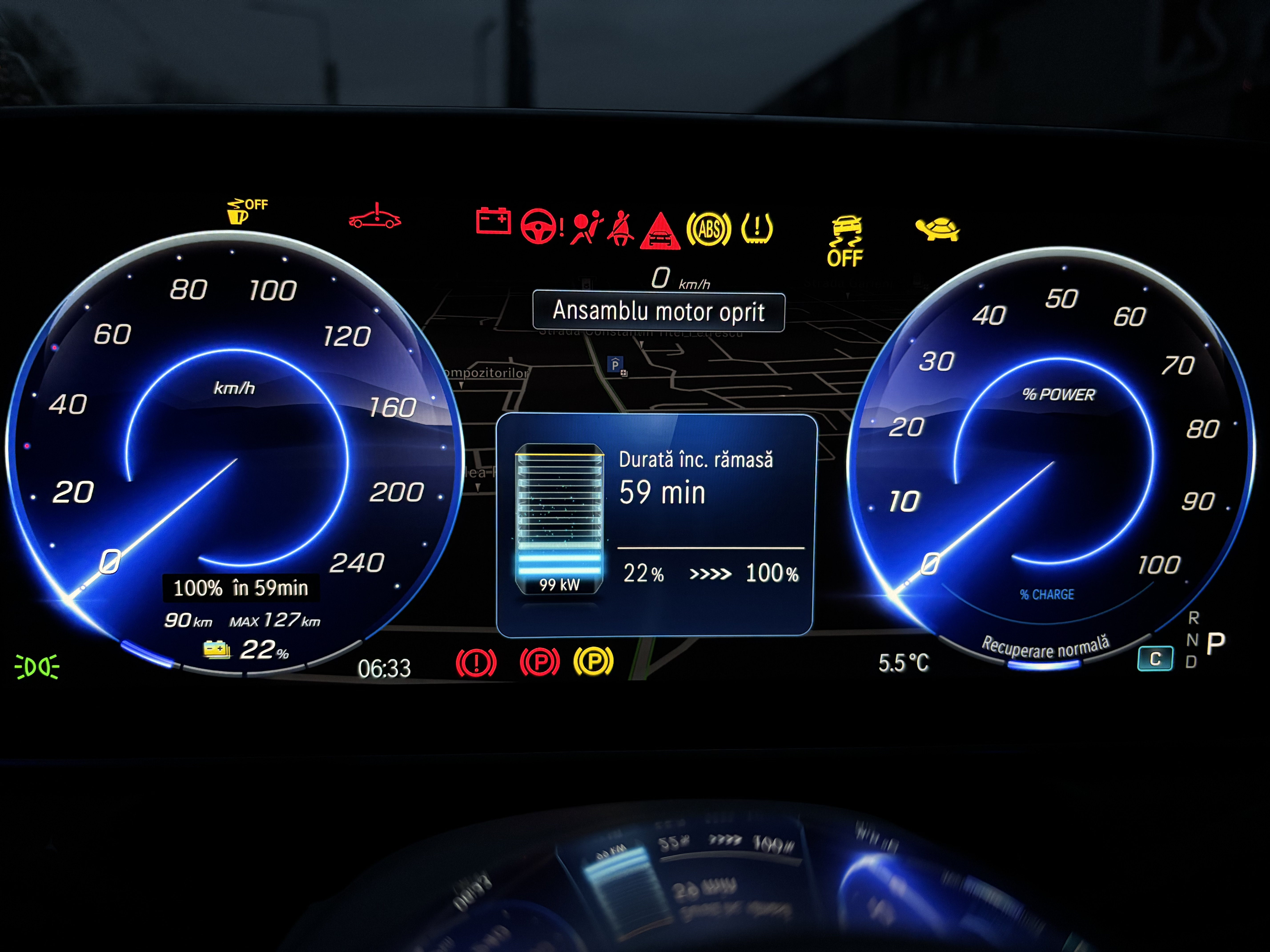
We charged the car once more from 18% to 47% at a faster 150kW charging station for 17 minutes and the charging speed climbed to 100 kW, so depending on the station and the charging conditions, you can juice it back a bit quicker. From 22%, the car estimated 59 minutes for a full charge, so not too bad at all.
Recuperative braking on the Mercedes-Benz EQE 300
Speaking of the recuperative braking, the Mercedes-Benz EQE comes with multiple forms of recuperative braking, such as standard, which will do a gentle braking to recover around 25% of the energy, strong recuperative braking, which almost always recover 100% of the power, as well as the intelligent system.
The intelligent recuperative braking works similarly to the one found in the MINI Aceman, a model that we tested, as well, and which you can learn more about here. Basically, when there's no vehicle in front of it, the car won't be braking in order to save energy, but it will rather coast. But, when you have a vehicle in front of you that is braking or drives slower, the EQE will start to apply braking stronger or more gently, depending on the conditions, to recover some of the energy in the battery.
I prefer the strong recuperation for the city or more packed traffic conditions, as it is a more efficient driving style if you can predict how other drivers are going around, so that you can recover more energy without touching the actual brakes. On longer trips, it will be more efficient to activate the intelligent braking recuperation, because when the traffic will flow, the car will coast gently and will only start to slow down when it notices a vehicle driving slower, using the adaptive cruise control.
By the way, this is another feature that works very well and that is very useful on a longer trip, because it helps you drive in a more relaxed and predictable way.
Comfort and materials in the Mercedes-Benz EQE 300
As far as the materials and the comfort are concerned, I have nothing bad to say about the EQE, it is after all an electric E-Class. The space is more than plenty in the front, but also in the back and in the boot, it's more than enough to take a couple of suitcases, but it's not the kind of car that you'll drive on a long vacation with your family full of luggage, but rather in a business trip.
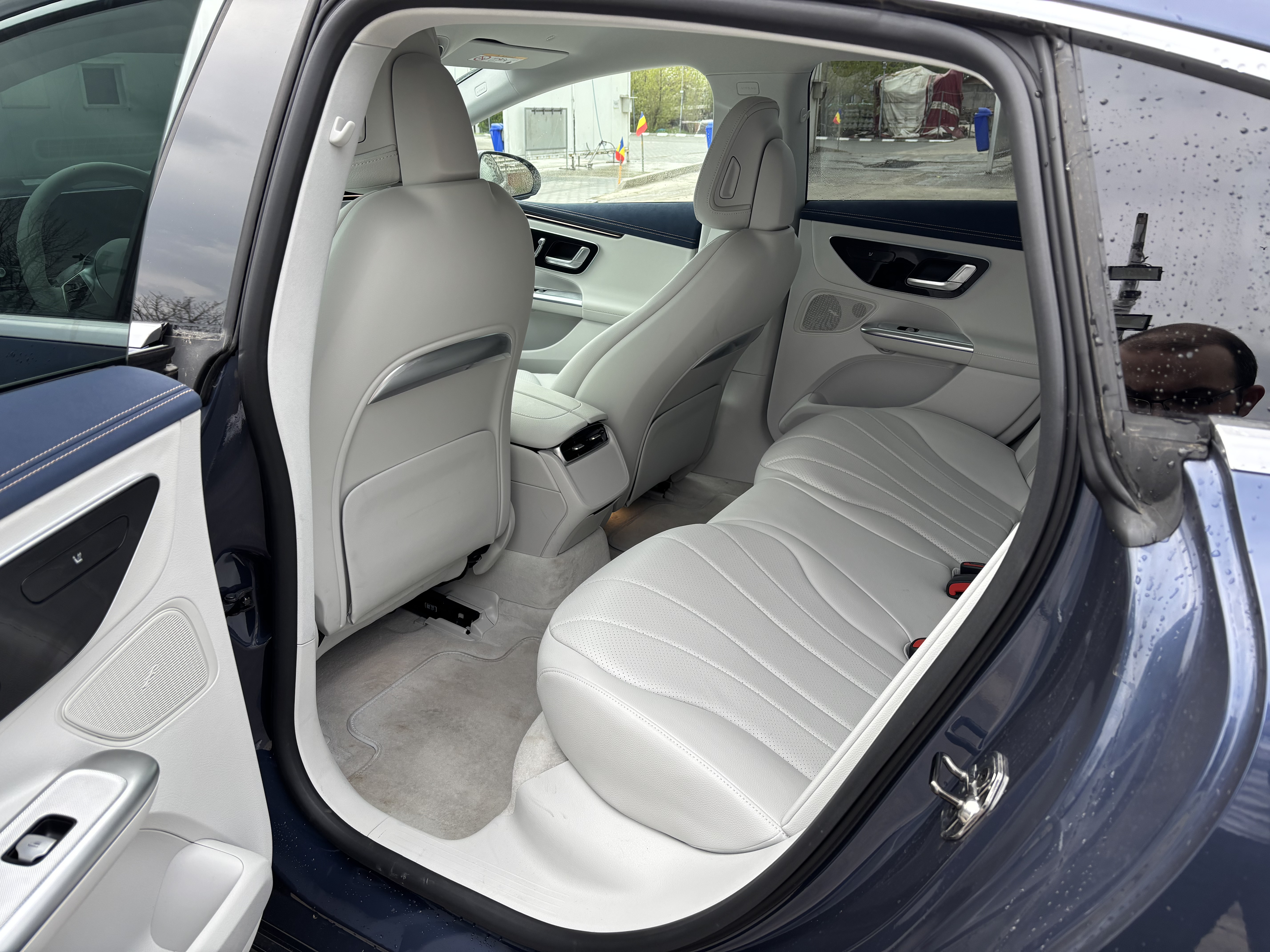
The materials, even though partly sustainable, made with recycled or alternative contents, feel good quality and will definitely make you feel like you are in a luxury electric vehicle. The seats are comfortable, especially on a longer drive, they are electric, have heating and massage features and the steering wheel is also heated itself, a useful feature if it's colder outside. The rear seats are also heated, a big plus for those who don't drive themselves, but always have a driver.
The climate system works on two zones at the front and there is a ventilation passageway for those in the back, as well, so nobody will be too cold or too warm in this car. By the way, the car comes equipped with a heat pump, so the climate system is more efficient and doesn't slash the range completely, but it also depends on the settings in the menu.
The front center console and armrest is big and has plenty of storage spaces, even below it and it is large enough for both passengers and so is the one in the back, but you'll need to sacrifice the middle seat. What I didn't like here is the cup holder in the front, which can be detached and feels kind of cheap, the one on our model being a bit old and having some glue on the bottom, not exactly great for an E-Class, especially since a replacement is around 80 euros.
Anyways, back on the build quality, the car is very solid, very heavy and the materials tell the same story. You'll find soft materials, such as velvet, leather and replacers and very little plastic, which is mostly on the tablets and the center consoles and which is in a piano finish. There is a bit more plastic above the glovebox, but that's matte and it has an interesting design pattern with the company's logo, a design element which I liked, but I would have preferred if there was the gray plastic alone.
Technologies in the Mercedes-Benz EQE 300
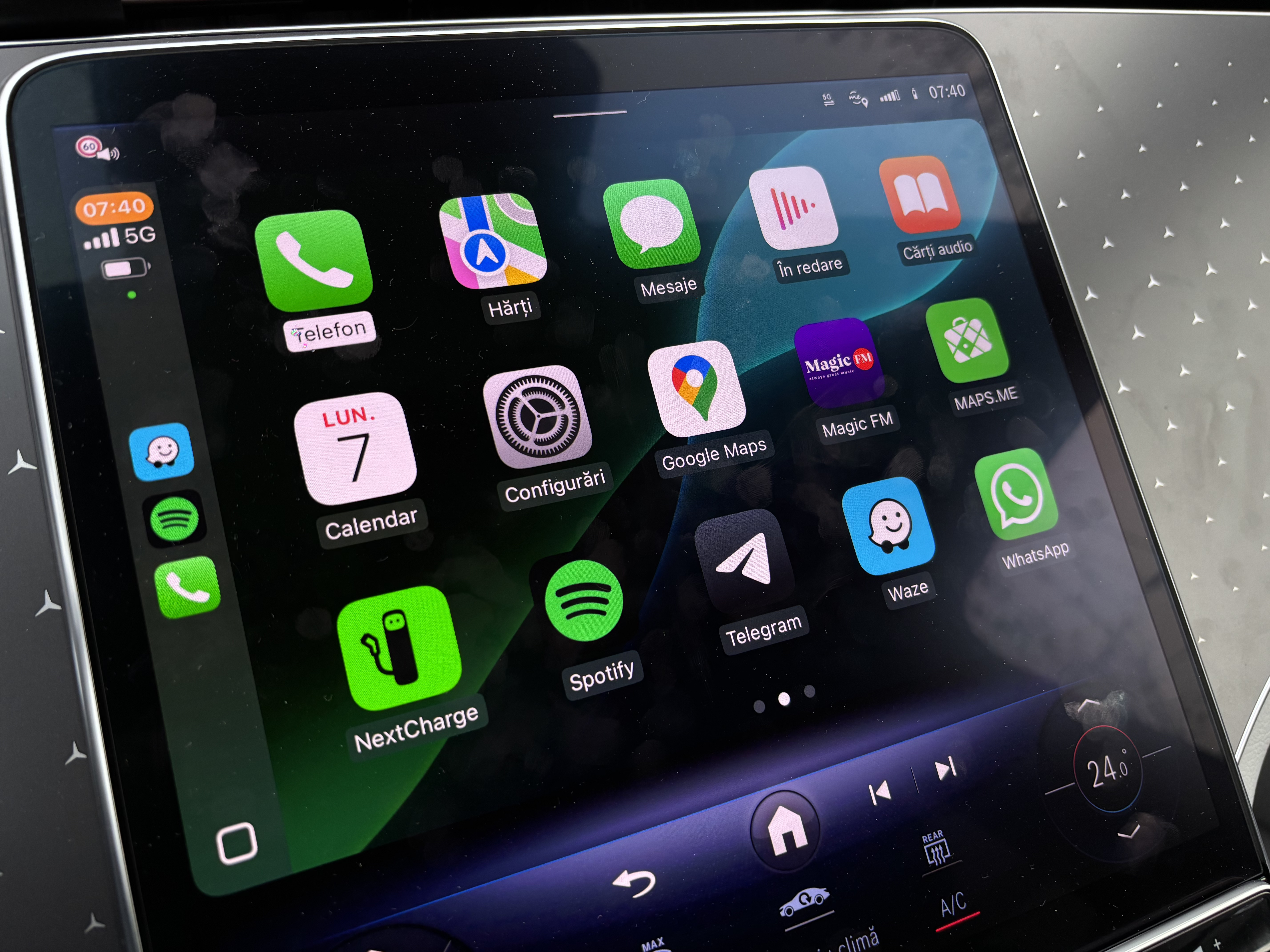
As far as the technologies are concerned, the EQE 300 surprises pleasantly, as it uses an operating system that is familiar to Mercedes drivers. Initially, the interface used by Mercedes engineers, called MBUX, seems old school, but I think that this kind of a design suits the models very well. It's a bit more elegant and serious, without compromising on features.
It's easy to navigate and fairly intuitive, there are also some physical buttons under the tablet, as I like to see. These are for the hazard lights, setting the vehicle's driving mode, turning the system on or off or changing the volume. The volume buttons I don't like very much, because they are not separated and are not only physical, but also touch-based and this may disorient you when you try to turn the music up or down.
There is also a fingerprint scanner that you can use to connect to a personalized profile, if you have the app installed on your phone. Speaking of the phone integration, Apple CarPlay works flawlessly and modernizes the interface. The car is instantly connecting to the phone and I didn't have lag or connectivity issues, while the microphones work very well, per the people I talked to.
There are plenty of buttons on the steering wheel, as well, but also like on the tablet, those are physical and tactile at the same time, so I almost never managed to turn the volume up or down bit by bit. Either I swiped too much and made a dramatic change in the setting or I didn't swipe enough, so no changes were made. I would like to see real physical buttons for these adjustments in the future.
I liked the fact that the car shows an estimated range in the dashboard, while you also see a maximum value, which is achievable by turning the climate system off and by driving in eco mode. The parking sensors and the cameras are good quality and do a good job, but if you take off a bit quicker in heavier traffic, the sensors might go off, leaving you the impression that you're too close to the person in front of you, when that's not the case. Perhaps they're a bit too sensitive, but I didn't go in the settings to check if they can be adjusted.
Our testing unit didn't have the panoramic sunroof, the optional screen for the passenger or the more advanced Burmester sound system, but rather the standard one, which still sounds excellent, just with fewer drivers.
Even in this less featured version, I felt like in a luxury model, very comfortable and very well suited for long trips. What I would have liked to have indeed was the panoramic sunroof, which looks more premium and which lets in more light on the inside, but otherwise, I was pleased with the whole package.
The car can also be configured with the 4Matic drive system for the versions with a front electric motor and you can also add a steering system for the rear axile, as well, which improves maneuverability in tight spaces.
Conclusions Mercedes-Benz EQE 300
For a little under 78.000 euros, the Mercedes EQE 300 is clearly a luxury electric vehicle, especially since our model was in a configuration with a price closer to the starting one, so the superior versions will cost even more. Still, even though it didn't have all the options and the weakest electric motor configuration, I didn't feel like anything was missing from this car, maybe with the exception of the panoramic sunroof. Otherwise, it offered the comfort, the space and the driving pleasure on a longer trip, plenty of power for any driving style and more than enough range even for those that aren't easy on the acceleration.
The BMW i5 could be one of the competitors for this car which has a similar starting price of almost 70.000 euros. We didn't drive a BMW i5 yet to get an idea about that car, but we know that for those who want to travel sustainably and in great comfort and don't need all the bells and whistles, the Mercedes-Benz EQE 300 could be a justified choice.
By contrast, a gasoline or diesel-powered E-Class starts at shy over 61.000 euros, but it doesn't have the same amount of power, the same options and it comes with other spending in mind, but also with a costly and more complicated maintenance.



Any thoughts?