 Mihai - Cristian Ioniță
For Dacia, Duster represents a successful model and I think this can be seen on the streets. I don't think I ever left my apartment without seeing at least one Duster on the road or in a parking spot. And it's easy to see why. Duster is large on the inside, but relatively small on the outside. It has excellent ground clearance and this doesn't help only on off road situations. If you need to climb on a sidewalk, for whatever reason, you'll be able to do that just fine in the Duster. But let's take everything one step at a time and talk first about the materials.
Duster 3, a more sustainable SUV from Mioveni
Only once have I ever had contact with a Duster and that was a model from the first phase. It was fairly comfortable, compared to the first generation of the Logan, without competing with more expensive models from Renault or Volkswagen, obviously, but the price isn't the same, either. And the materials inside were quite ordinary, plastic and that's about it, but then again, you can't expect for more in this budget.
What changed? Almost nothing. The Duster is still a practical model, made with lots of plastic, but it doesn't need to prove anything when it comes to how luxurious the materials feel, but it rather needs to be built solid and honest, without leaving the impression that it was an unfinished job.
And this is exactly how I would describe the Duster 3 HEV 140, since we don't have anything but hard plastic on the inside, with the only exception being, obviously, the seats, which are made from textile materials. Is that a bad thing? I don't think so, since you won't be knocking on the hard plastics all day long (or at least I hope you won't). The car serves its purpose more than fine, it's practical and that's about it. What matters more, in my opinion, is that it doesn't creak and it doesn't make weird noises that would otherwise reflect a poor build quality.
So, if we have all that plastic, why am I saying that the Duster 3 is a more sustainable SUV? I'll explain it to you in a minute.
It's true that the car I had for testing was basically brand new and material fatigue hasn't settled yet, but if my dad's 16 year-old Dacia Logan is anything to go by, perhaps the long-term build will impress in the new Duster, too.
Still, I was very impressed to find that Dacia implemented lots of recycled plastics on this model. You have reprocessed plastic both on the inside and the outside and the components that use recycled materials are engraved with a "recycled" symbol.
The plastic, even if it's recycled, doesn't look and feel bad at all, in fact it's not any different compared to the virgin materials that would have otherwise replaced it. The textile fibers also come from planet-friendly resources, just like it's the case for Renault models from the new generation.
On the outside, the Duster 3 uses 20% recycled plastic for all its sides. This material has an interesting texture, as it looks unpolished, but it's an intentional choice made by the designers, which means that every car will be unique due to the small colorful dots.
The sustainability aspect of the Duster 3 is supported by the recycled materials, installed on the inside and the outside of the car, as well as by the engine selection, which are either hybrids or LPG (liquified petroleum gas) models. By using LPG, a fossil fuel that burns more efficiently and almost completely compared to gasoline, is more planet-friendly and thus, it releases fewer emissions per liter of fuel.
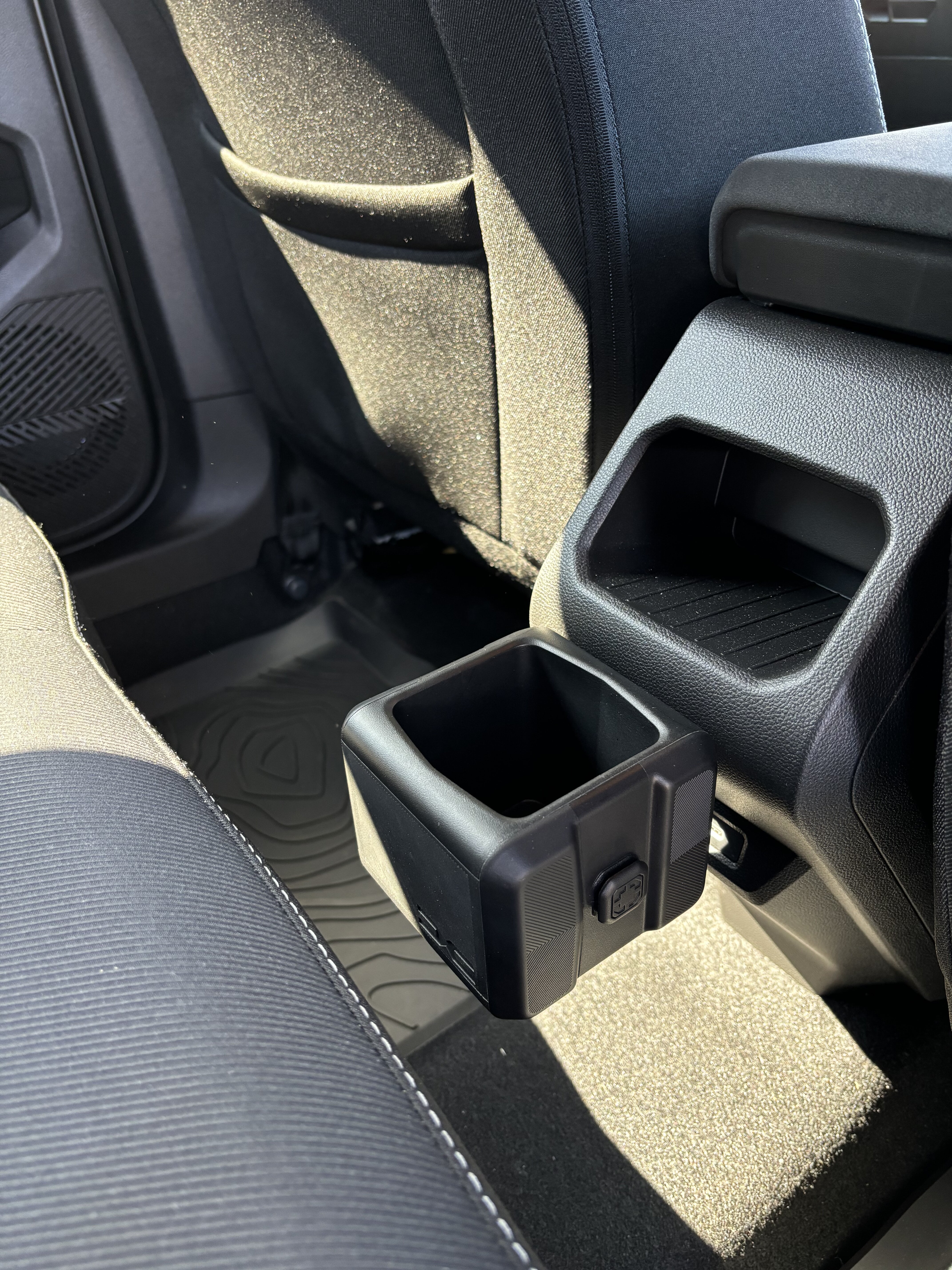
In the Duster 3 you have plenty of space for its category, but then again, don't expect it to be as spacious as a Touareg, for example, because that's not the case. The boot has 470 liters of capacity, again decent for this chassis and the rear seats can be folded for extra space. When talking use of space, all the buttons are placed in the right spots, so you can easily reach all the controls and the armrest is very generous, especially if you're smaller, like I am. There is one thing I didn't like in particular; the slots for the front seatbelts are placed between the seats and the armrest and if you have the seat more towards the back, you will have some issue buckling up.
Again, me being small and having the front seat more towards the front of the vehicle, this was not a problem, but for the passengers it was quite a discomfort. For future models, perhaps the designers can keep this in mind and at least make it so that the armrest can slide forwards and backwards, so that the seatbelts can be fastened faster and more easily.
As far as the platform goes, it doesn't creak even if you take the car on a dirt road (but again, the car was new), but it also sits shockingly good on the highway, too, but we'll talk more about the driving impressions in a minute.
So, as far as construction goes, the Duster is an honest car, well-built but without leaving you in awe in this regard, but it won't let you down, if you know what to expect.
How the Duster 3 behaves on the road, but also off it
Here I must admit that I was extremely pleasantly surprised. I took the car for a spin on the highway and I drove it there for around 60 kilometers, at speeds ranging between 120-130+ km/h. What I did not expect was to drive a compact SUV that's not very heavy at under 1.4 tons, with a large ground clearance and fairly narrow tires, but which sits planted on the road. As far as the 1.2 mild-hybrid version that others have tested, they said that it wasn't particularly spectacular in that regard, because the car isn't as stable on the road for one reason or another. My guess is that this depends on the suspension setup, as well as the overall weight of the vehicle or the 3-cylynder engine.
On the Duster 3 HEV 140 we have a fully hybrid setup, with a 48 horse power electric motor that is completed by a gasoline one making 94 horses. Combined, they output 140 HP and a torque of 205 Nm, more than enough for driving them comfortably on long hauls, as well as offering a generous power reserve for overtaking, for example.
Being a 4-cylinder, the gasoline engine makes it so that the car won't vibrate and you can barely feel it when it turns on. The switch from electric to gasoline happens very smoothly, except when you go pedal to the metal. That's when you'll feel it shake under the hood, as it prepares to give you the best possible acceleration for the scenario.

The motor setup is managed by a multimode gearbox, with two gears for the electric motor, as well as four gears for the gasoline-powered unit. The system mostly does a great job and you don't notice the gear shifts, but just like on the Rafale, for which we have a separate test drive that you can read here, the gearbox has the slowest shift speed at 120 km/h, when it goes from third to fourth.
Because I got used to this system from the previously-tested Dacia-Renault models, I wasn't surprised and I knew how to manage my overtaking time, but at first, it might trick you if you aren't familiar with it.
Duster 3 HEV 140 is very nimble in the city, which is where I think the car will excel. Not only will you get nice fuel economy at 5 liters per 100 kilometers or less, if you are more careful with the accelerator or you don't necessarily want to use the automatic air conditioning, but the electric motor offers excellent take-offs for its 48 HP if you need to quickly change lanes.
I did that once effortlessly and didn't even need to put the accelerator all the way down. All in electric, as well. The gasoline-powered engine will start from time to time, so that it can charge the battery. In about 30 seconds, it can charge back some 25%, which is enough to start from zero a few times or even to drive for a few kilometers at under 50 km/h. The battery indicator has four lines, each representing 25% of the total capacity, just like on the Dacia Jogger, for which you can read a separate test drive here.
When the battery reaches the final line, meaning 25%, the gasoline engine will automatically start to charge it back to around 50%. The battery will also charge itself on braking, if you don't press it too hard. Duster 3 has a "B" mode as well, which stands for braking, and which simulates an engine braking scenario, but created by the electric generator, rather than the combustion engine.
The engine braking isn't as noticeable here as it is for Renault cars and it doesn't recuperate as much power, so you'll have to help the car yourself with the pedal.
A second electric motor, 20 HP this time, only acts as a starter for the combustion engine and it can also run the car's different electronic and mechanical systems, such as the air conditioning pump, for example.
It's important to note that Duster 3 is Dacia's first car with braking disks on the back wheels. It is something that many people wanted and is now on this car, too, but you'll have to take some things into account before buying the car yourself. The system is available on all Journey models of the Dacia Duster and on the Extreme, you can have it if you choose the Techno pack.
Why? Because the rear disk braking system comes hand in hand with the electronic parking brake, so models with manual handbrake still come with drum brakes.
Do you feel the disks on the back? Arguably no, in my opinion, as I didn't feel the need for disks on the Jogger either, as Dacia cars are not the heaviest out there that will need the most advanced braking systems, like it's the case for Renault models, for example.

Off road wise, the Duster 3 behaves admirably, it has almost 21 centimeters of ground clearance (20.9 to be exact), so you can take on even moderately challenging terrains, but beware, as the 4x4 system is only available on the 1.2 gasoline engine with 3 cylinders. So, it's up to you if you value lower fuel consumption, lower taxes and a more comfortable ride overall, or you need 4x4 traction.
What safety features can you expect on the Duster
As I said in the test drive for the Jogger, as new technologies became more affordable, Dacia models were some of the first to benefit from this and they now offer more safety features than ever before. Reverse camera? We have it. Adaptive rear and front parking sensors? We have them, too. How do they work? Simply put, if you are steering towards an obstacle and the car feel like you're about to collide with it, you will be warned both acoustically and visually. But if you were to steer in the opposite direction, for example, the warning will stop, as the new trajectory will mean that you will no longer collide. It's very smart and I am happy we have it here and it's not just an exclusive for more expensive cars, like the Scenic E-Tech.
What else do you get on the Duster that will make you a safer driver? Lane assist that helps you stay in your lane, literally, a feature that works very well all the time, driver monitoring, which will tell you when it thinks you might be a bit too tired to continue, you have airbags in all the important places and emergency call directly above the driver in case of an accident.
Duster 3 doesn't have all the bells and whistles in terms of safety features, due to the much lower price compared to models that do, but it offers you more than the bare minimum for you to start your journey without being concerned for your life.
I felt very safe in this car, even on the highway, where it helped me keep my lane if I was moving too much left or right.
About the navigation system I talked more about when I had the Jogger, it's the same system here, as well, easy to understand and use. All the buttons, physical or digital, are large and well positioned so that you don't have to look too hard for them.
Price and conclusion
Duster 3 starts from 18.800 euros and can go all the way up to almost 27.000 for the top Journey trim that I had. Is it a fair price? That's up to you to decide, but all auto makers suffered due to the inflation. The only problem I can see here is that the Renault Captur, which is arguably the more premium Duster 3, starts at a lower price than the top trim of the Duster. Being a Renault, that car comes with its own upsides, such as the better build quality or the upgraded Google navigation system that the French use.
Still, Duster is a bit more practical, it's more spacious in its boot, a little lighter and has more ground clearance, making it the more suitable option for off road situations.
What would I recommend if you're looking to get a Duster 3? If you don't absolutely need the 4x4 system, make an effort and get the full hybrid version. The initial high investment will be compensated in the long run by the lower taxes, the much better fuel economy and the above-average power this car outputs.
As far as safety features go, pick each that doesn't come as standard and you think you might need.
Duster 3 can be one of the most well-balanced options on the market and with not much competition for the price. It's compact enough that you can drive fairly easy in the city, but the 4x4 system and high ground clearance make it an excellent choice for the situations when asphalt isn't an option.



Any thoughts?